This browser can't draw the 3D rat (WebGL2 is off). The facts below still work.
VIEW
OUTSIDE
BONE
ORGANS
MOTIONSTANDING · 0.00 M/S
RENDER
EXPLODE
FORMATDRAG TO TURN · PINCH OR WHEEL TO ZOOM · TAP A PART TO NAME IT · DOUBLE-TAP TO RESET
SPECIMEN 001 · RATTUS NORVEGICUS
RAT FACTS
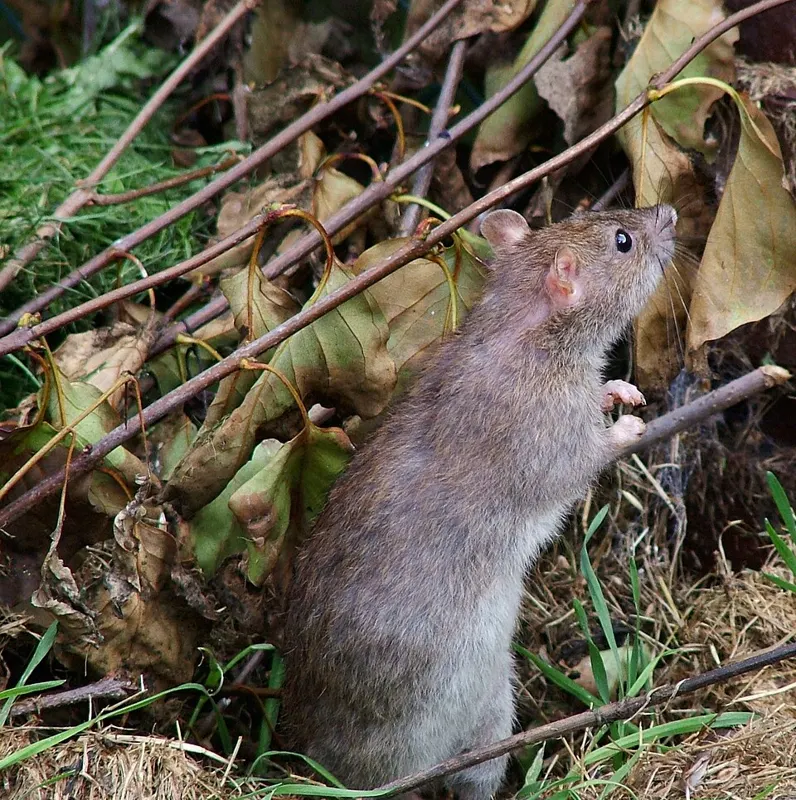
A real brown rat and a real CT-scanned skeleton, rebuilt from 150,000 grains per layer. Scroll to go under the fur, one layer at a time. Drag, pinch or scroll-wheel the rat to turn and zoom it, and open EXPLORE to take it apart.
SCROLL ▼
01 · WHISKERS
Rats see the world with their face.
A rat sweeps its whiskers forward and back about 8 times a second, tapping out the shape of everything around it in the dark.
Each big whisker has its own patch of brain, a "barrel" in the cortex, so the whisker grid on the face is copied onto the brain.
5-15 Hzwhisking speed. The whiskers here whisk in bursts, at real speed.
02 · EARS
They laugh where you can't hear.
Rat hearing reaches roughly 80 kHz, far past the human limit near 20 kHz.
When young rats play, or a researcher tickles them, they chirp at about 50 kHz. Jaak Panksepp's lab called it laughter, and tickled rats chase the hand for more.
~4xhigher than the top of human hearing
03 · TEETH
The teeth never stop growing.
Rat incisors grow for life, around 2 to 3 mm a week, and gnawing wears them down just as fast.
The front enamel holds iron, which turns it orange and keeps the edge chisel sharp. Behind the incisors is a gap the cheeks fold into, so a rat can gnaw through wood without swallowing it.
~12 cmof incisor grown in a year
04 · SKULL
If the skull fits, the rat fits.
The skull is the widest hard part of a rat. An adult brown rat can squeeze through a gap about 2 cm wide, roughly the size of a coin.
The ribcage and shoulders are flexible enough to follow wherever the head can go.
05 · SPINE
About 30 bones in the tail alone.
The rat spine is C7 T13 L6 S4: seven neck bones (the same count as yours), thirteen that carry the ribs, six lumbar, four fused at the hip.
Then the tail adds another 27 to 30. Thirteen pairs of ribs hang off the thoracic set.
57-60vertebrae, nose to tail tip
06 · MUSCLE
Built to swim, climb and dig.
Brown rats are strong swimmers. They can tread water for hours, hold their breath for a few minutes, and travel through flooded pipes.
They climb rough walls, run along cables, and dig burrows with nests, food stores and escape exits.
07 · BRAIN
A smooth brain with a sharp map.
The rat cortex has no folds. It still holds place cells, neurons that fire when the rat is in one particular spot. John O'Keefe found them in rats and shared the 2014 Nobel Prize for it.
During sleep, rats replay the routes they ran that day, in order, as if rehearsing the maze. The two big bulbs at the front are for smell, their main sense.
08 · NERVES
Wired for whiskers.
The spinal cord runs inside the spine, and a pair of nerves leaves between each pair of vertebrae. Under every rib runs an intercostal nerve; two vagus nerves run from the brainstem down the neck to the heart, lungs and gut.
The whisker pad is served by the infraorbital nerve, one of the biggest sensory nerves in a rat's face. The pulses running along the nerves here show signals travelling.
09 · HEART + LUNGS
Over 300 beats a minute.
An adult rat's heart beats around 250 to 450 times a minute, five to seven beats a second. It breathes about 70 to 115 times a minute.
The heart and lungs on screen run at real speed.
~360beats per minute, as drawn
10 · GUT
A rat cannot throw up.
Rats lack the brainstem reflex that drives vomiting, and their anatomy works against it too. So they taste-test: a wary rat eats a crumb of something new, waits, and avoids it for good if it feels sick. It's a big reason poison bait so often fails.
Rats have no gallbladder, and a large cecum ferments the fibre.
11 · TAIL
The tail is a radiator.
The tail is bare for a reason. Blood vessels in it shed body heat, so the tail works as a radiator, and it helps with balance on ledges and wires.
It is covered in rings of scales and nearly as long as the body.
12 · MIND
They free their friends.
In a 2011 University of Chicago study, rats learned to open a trapped cagemate's restrainer, and kept doing it, even when a pile of chocolate chips was the other choice.
They often freed the friend first, then shared the chocolate.
13 · LIFE
A short, crowded life.
A wild brown rat lives about 1 to 2 years, a pet one 2 to 3. Females can breed from about 5 weeks old, pregnancy lasts about 3 weeks, and a litter of 6 to 12 can follow every month.
SPECIMEN OPEN
Take it apart yourself.
Open EXPLORE to fly around it on any axis, zoom right into the grains, and make it stand, walk or run. Then try the other tabs: the strange facts, rats in research by the numbers, and the places that eat rats.
Body: "Street Rat" photoscan by Sean Buckley, Poly Haven (CC0). Skeleton: "Rat Skeleton" X-ray CT scan, NIH 3D Print Exchange 3DPX-000361 (CC-BY), reposed from lying flat to standing; its missing tail bones are drawn in. Muscle and organs are illustrated to fit: right in placement, not exact.
UNCOMMON RAT FACTS
Real, sourced, and stranger than the usual list.
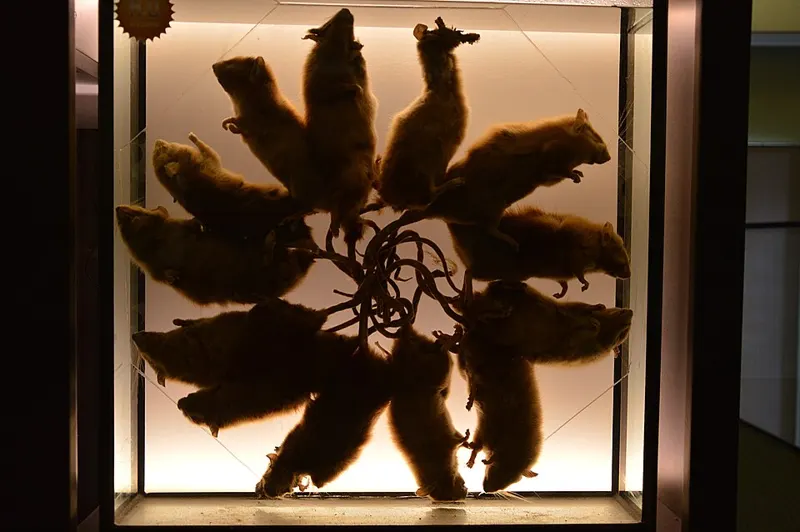
The 2005 Estonian rat king, University of Tartu museum. Photo: Ivo Kruusamägi, CC BY-SA 4.0
Rat kings are real, and still unexplained.
A rat king is a knot of rats stuck together by their tails. The biggest preserved one, 32 black rats, sits in the Mauritianum museum in Altenburg, Germany. A live one, 16 rats, was found on a farm in Estonia in 2005. Nobody has proven how they form.
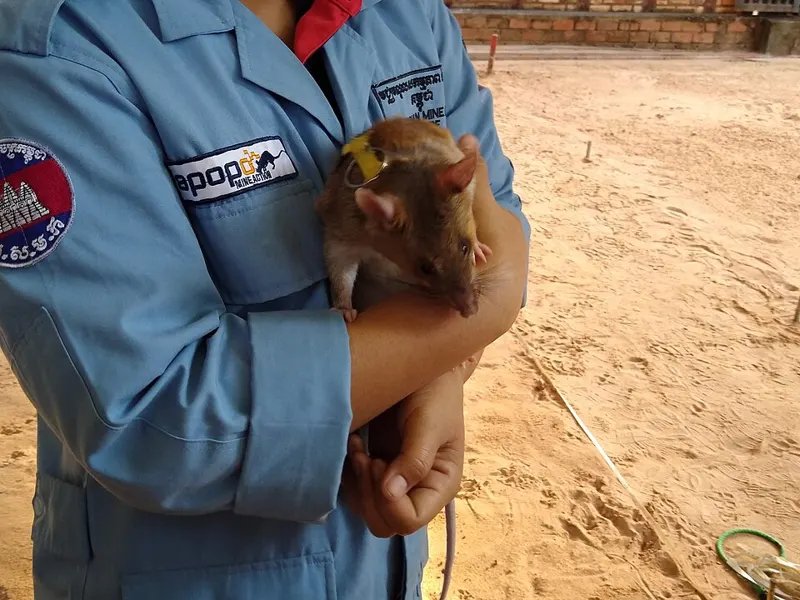
Magawa, an African giant pouched rat trained by APOPO in Tanzania, sniffed out 71 landmines and 38 other unexploded bombs in Cambodia. In 2020 he got the PDSA Gold Medal, the animal George Cross. He weighed too little to set off a mine.
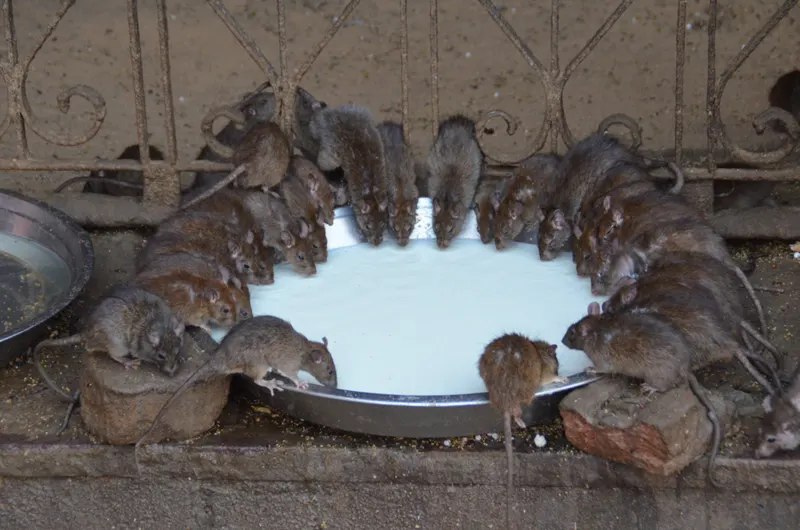
Karni Mata temple, Deshnoke. Photo: Günther Jontes, CC BY 4.0
A temple in India feeds 25,000 rats.
At the Karni Mata temple in Deshnoke, Rajasthan, rats are holy. Pilgrims share food the rats have nibbled, and spotting one of the rare white rats is a blessing.
Karni Mata Temple, Deshnoke, Rajasthan
Rats can learn to drive.
In 2019 Kelly Lambert's lab built tiny cars from plastic food tubs. Rats learned to steer them to a Froot Loop by gripping a copper bar. Driving seemed to calm them down.
Researchers in Berlin taught rats hide and seek with no food reward. The rats learned both roles, picked smarter hiding spots, kept quiet while hiding and chirped with joy when found.
Reinhold et al., Science, 2019
Rats bob their heads to music.
A University of Tokyo team found rats move their heads in time with music, best at 120 to 140 beats a minute, the same range humans prefer. Mozart worked.
In a rat "restaurant row", rats that skipped a good deal and then hit a bad one looked back at the deal they missed, and their brain activity replayed it. Then they changed how they chose.
Steiner & Redish, Nature Neuroscience, 2014
Bamboo blooms, then rats swarm.
In Mizoram, India, bamboo flowers all at once about every 48 years. Rats gorge on the seed, explode in number, then eat the rice crops. The mautam of 1958-59 caused a famine; it came back in 2006-08.
Mautam, Mizoram
Whole places are rat-free on purpose.
Alberta, Canada, has kept out brown rats since the 1950s with border patrols. The island of South Georgia was declared rat-free in 2018 after the world's biggest rodent eradication.
Alberta Agriculture; South Georgia Heritage Trust, 2018
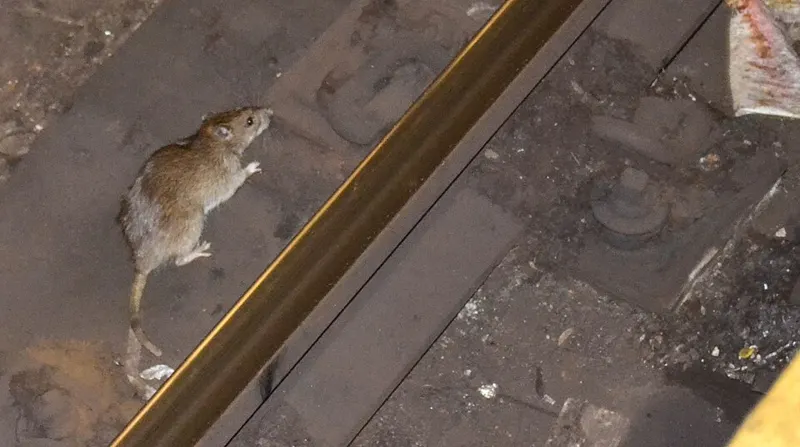
New York City subway. Photo: m01229 from USA, CC BY 2.0
"One rat per New Yorker" is a myth.
The line traces back to a 1909 guess about England. A 2014 study using rat sightings estimated about 2 million rats in New York City, roughly one for every four people.
Auerbach, Significance, 2014
The Black Death may not have been the rats' fault.
A 2018 modelling study found the death patterns across nine European outbreaks fit human fleas and lice better than rats.
Dean et al., PNAS, 2018
RATS IN RESEARCH
Rats are the second most used lab mammal after mice. Here's how many, where, and the experiments that made them famous.
THE MISSING NUMBERThe United States, probably the biggest user, does not count lab rats at all: the Animal Welfare Act leaves out rats and mice bred for research. Every US figure below is an estimate.
BY THE NUMBERS
~192M
animals used in science worldwide each year
Estimate for 2015, most of them mice and rats. Taylor & Alvarez, 2019
625,777
rats used in the EU + Norway, 2022
7.5% of 9.24 million animals. European Commission data
150,221
procedures on rats in Great Britain, 2024
About 10% of experimental procedures. Home Office
25-111M
mice and rats used in the US each year
Range of published estimates; 111.5M is Carbone, 2021
Mice
47.8%
Fish
30.3%
Rats
7.5%
Everything else
14.4%
THE LAB RAT IS ONE FAMILY
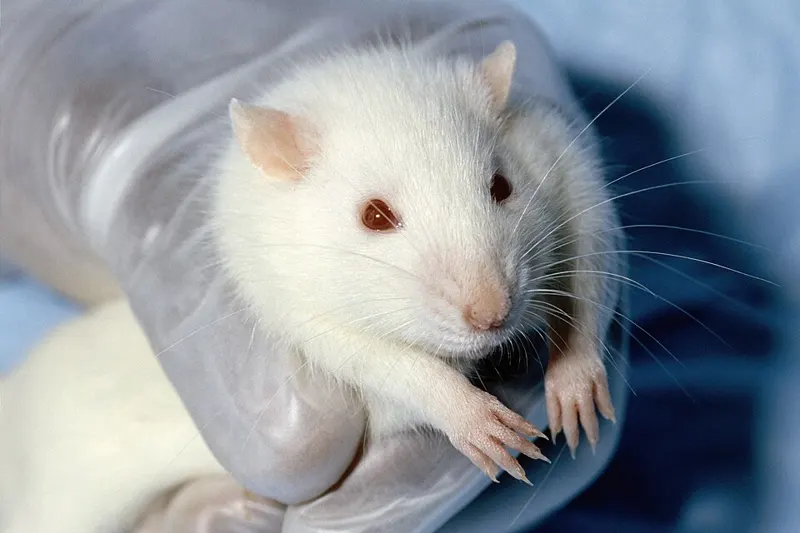
An albino Wistar rat. Photo: Janet Stephens (photographer), Public domain
Wistar, 1906
Bred at the Wistar Institute in Philadelphia as the first standardized lab animal. Most lab rats alive today descend from this albino line.
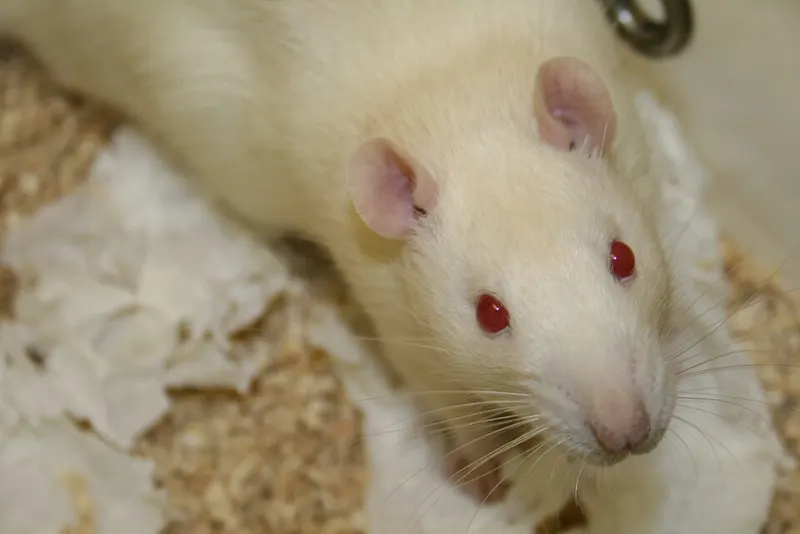
A Sprague Dawley rat. Photo: Jean-Etienne Minh-Duy Poirrier, CC BY-SA 2.0
Sprague Dawley, 1925
A calm, fast-growing Wistar offshoot from Madison, Wisconsin. Now the workhorse of toxicology and drug safety testing.
BRED FOR DISEASE
Zucker, nude and knockout rats
Some strains are bred to be sick. Zucker rats (1961) grow obese and diabetic. Nude rats have no thymus and no hair, so they can't reject human tumors. Gene-edited knockout rats carry human disease genes.
FAMOUS RAT LABS
Where the best-known rat science happened. Every one of these findings came from rats in that building.
PHILADELPHIA, USA · 1906
Wistar Institute
Henry Donaldson and Helen Dean King bred the first standardized lab rat here. King then inbred rats for over 100 generations, producing one of the first inbred strains.
BALTIMORE, USA · 1920s-1970s
Johns Hopkins, Curt Richter's lab
Richter spent decades on rat biological clocks, appetite and stress. The lab is also where his 1957 swimming experiments ran.
MONTREAL, CANADA · 1954
McGill University
James Olds and Peter Milner found the brain's reward system by wiring electrodes into rats that then pressed a lever to stimulate themselves.
MARYLAND, USA · 1950s-1970s
NIMH, John Calhoun
The National Institute of Mental Health ran Calhoun's crowding studies, first with rats in a barn, later with mice in "Universe 25".
LONDON, UK · 1971
University College London
John O'Keefe recorded single neurons in moving rats and found place cells, the start of the brain's map. Nobel Prize, 2014.
TRONDHEIM, NORWAY · 2005
Kavli Institute, NTNU
May-Britt and Edvard Moser found grid cells in rats, neurons that tile space in a hexagon pattern. They shared the 2014 Nobel with O'Keefe.
BURNABY, CANADA · 1978-81
Simon Fraser University
Bruce Alexander built Rat Park, a big social enclosure, to test whether isolation drives morphine use.
PULLMAN, USA · 1990s-2000s
Washington State University
Jaak Panksepp's team tickled rats and recorded their 50 kHz chirps, the work behind "rats laugh".
CHICAGO, USA · 2011
University of Chicago
Inbal Ben-Ami Bartal and Peggy Mason showed rats free trapped cagemates and share chocolate with them.
BERLIN, GERMANY · 2019
Humboldt University
Michael Brecht's lab taught rats to play hide and seek for fun, with no food reward.
MOROGORO, TANZANIA · since 2000
APOPO
Trains African giant pouched rats, a different species from the brown rat, to sniff out landmines and tuberculosis.
WHERE LAB RATS COME FROM
SUPPLIER · SINCE 1947
Charles River Laboratories
Started by Henry Foster with a few thousand rat cages near Boston. Now one of the world's largest suppliers of lab animals.
SUPPLIER · SINCE 1931
Inotiv (formerly Harlan, then Envigo)
Another of the big breeders. Sprague Dawley rats are among its standard lines.
STRAIN BANK · USA
Rat Resource & Research Center
At the University of Missouri, funded by the NIH. It stores and ships hundreds of rat strains, many as frozen embryos.
STRAIN BANK · JAPAN
National BioResource Project, Rat
Kyoto University's bank of rat strains, one of the largest collections in the world.
DATABASE · USA
Rat Genome Database
Run from the Medical College of Wisconsin. It tracks rat genes, strains and the diseases they model.
KNOWN TRIALS
CONTENT NOTESome of these trials harmed or killed the rats.
1856
The first lab rats
Jean Marie Philipeaux removed the adrenal glands of albino rats in Paris, one of the earliest recorded rat experiments.
1954
The pleasure lever
James Olds and Peter Milner put electrodes in rats' brains. Rats pressed a lever to stimulate them, some thousands of times an hour, ignoring food.
1957
The swimming test
Curt Richter put rats in tanks of water they could not escape. Some gave up within minutes; rats that had once been rescued swam for many hours. Swim tests like it are still argued over today.
1962
Rat utopia
John Calhoun gave rats food and water without limit and let them crowd. Mothering broke down, violence rose, and he called it a "behavioral sink".
1977
Saccharin and bladder tumors
Huge doses gave male rats bladder cancer, and saccharin got a US warning label. It came off in 2000 once the cause was found to be specific to rat urine.
1978-81
Rat Park
Bruce Alexander found rats housed alone drank far more morphine water than rats in a big, social "park". Follow-up studies gave mixed results.
2004
The rat genome
The brown rat became the third mammal to have its genome sequenced, after humans and mice.
2012
The tumor photos
Gilles-Eric Séralini's study showed Sprague Dawley rats with large tumors after eating GM maize. The journal retracted it in 2013 over its small groups and a strain prone to tumors anyway; it was republished elsewhere in 2014.
2014
The brain's GPS
O'Keefe and the Mosers won the Nobel Prize for place cells and grid cells, both found in rats.
MAZES: HOW RATS TAUGHT US MEMORY
Rats explore, remember routes and plan. Mazes turned that into numbers, and most of what we know about memory and spatial learning started here.
CLARK UNIVERSITY, USA · 1901
The first rat maze
Willard Small built the first maze for rats, modelled on the hedge maze at Hampton Court, to watch how they learn a route.
UC BERKELEY, USA · 1930s-1948
Cognitive maps
Edward Tolman let rats wander a maze with no reward. When food appeared, they ran it almost perfectly: they had been learning the layout all along. He called it a cognitive map.
JOHNS HOPKINS, USA · 1976
The radial arm maze
David Olton put food at the end of eight arms around a hub. Rats rarely revisit an arm they have already emptied: a clean test of working memory.
SCOTLAND · 1981
The Morris water maze
Richard Morris put rats in a pool of cloudy water with a hidden platform just under the surface. Using marks around the room, rats learn where it is. It is still the standard test of spatial memory.
EVERYWHERE
T-mazes, Y-mazes, Barnes maze
Simple left-or-right choices test memory and decisions. Rats naturally alternate arms. The Barnes maze swaps water for a bright table with one dark escape hole.
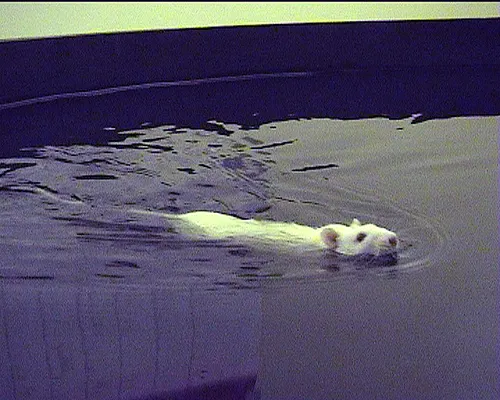
A rat swimming the Morris water maze. Photo: Jean-Etienne Minh-Duy Poirrier, CC BY-SA 2.0
Memory under water.
The rat cannot see the platform. It swims, finds it by chance, and on later trials heads straight there using landmarks on the walls. Damage to the hippocampus wipes that out, which is how the test linked the hippocampus to spatial memory.
SWIM TESTS
CONTENT NOTEThese tests put animals in water they cannot escape.
JOHNS HOPKINS, USA · 1957
Richter's swimming rats
Curt Richter timed how long rats swam in tanks they could not escape. Some gave up in minutes; rats that had once been rescued kept going for many hours. He called it hope.
FRANCE · 1977
The forced swim test
Roger Porsolt placed rodents in a water cylinder and timed how long they swam before floating. Floating was read as "despair", and for decades the test screened new antidepressants.
2010s-2020s
Doubts, and companies stepping back
Critics argue floating may just be learning to save energy. UK medicines regulators concluded the test does not predict whether an antidepressant works, and several large drug companies say they no longer use it.
BODY PARTS GROWN IN THE LAB
CONTENT NOTETissue engineering and transplant research on live animals.
UMASS, USA · 1997
The "ear mouse"
The famous photo of an ear on an animal's back shows a mouse, not a rat. The ear was a scaffold in the shape of a human ear, seeded with cow cartilage cells and grown under its skin. No genes were changed and it was never a working ear.
UNIVERSITY OF MINNESOTA · 2008
The ghost heart
Researchers washed every cell out of rat hearts, leaving a pale collagen frame, then reseeded it with young heart cells. Within days the rebuilt heart began to beat.
YALE AND HARVARD · 2010
Lab-grown lungs
Two teams rebuilt rat lungs the same way and transplanted them. The new lungs exchanged oxygen, though only for hours.
MASSACHUSETTS GENERAL · 2013
A rebuilt kidney
A bioengineered rat kidney, grown on a stripped-down scaffold, was transplanted into a rat and made urine.
STANFORD, USA · 2022
Human mini-brains in rats
Sergiu Pașca's team transplanted human brain organoids into newborn rats. The human cells wired into the rat's cortex and responded when its whiskers were touched, and rats learned to seek water when those cells were switched on.
DRUG SAFETY RULES
Birth-defect testing
New drugs are tested for birth defects in pregnant rats and rabbits. Two species are used because thalidomide caused few defects in rats but clear ones in rabbits.
BRAINS WIRED TO MACHINES
SUNY DOWNSTATE, USA · 2002
Remote-controlled rats
Electrodes in the whisker and reward areas of rats' brains let researchers steer them left and right over ramps and through rubble from a laptop.
UNIVERSITY OF FLORIDA · 2004
Rat neurons fly a jet
About 25,000 rat brain cells grown on an electrode grid in a dish learned to keep an F-22 flight simulator level.
DUKE, USA AND NATAL, BRAZIL · 2013
Brain-to-brain
Miguel Nicolelis linked two rats' brains over the internet. A rat in Brazil solved a task, and its brain signals helped a rat in North Carolina choose the right lever.
NEURALINK · 2019
Neuralink's first animals were rats
Neuralink's first public paper described thin electrode threads, up to 3,072 electrodes on 96 threads, sewn in by a robot. Its recordings came from rats: 19 were implanted.
NEURALINK · 2020-2024
Pigs, monkeys, then people
Neuralink showed a pig with an implant in 2020 and a monkey playing Pong with its mind in 2021. US regulators cleared human trials in 2023, and the first person was implanted in January 2024.
NEURALINK · 2022
The animal cost
Reuters reported that about 1,500 animals, including more than 280 sheep, pigs and monkeys, had died in Neuralink testing since 2018, with staff saying some deaths came from rushed work. A federal inquiry into its animal welfare followed.
In some places rat is ordinary food, in some it's a delicacy, and in a few it was survival. "Rat" here sometimes means a bigger rodent with the name, and each card says which.
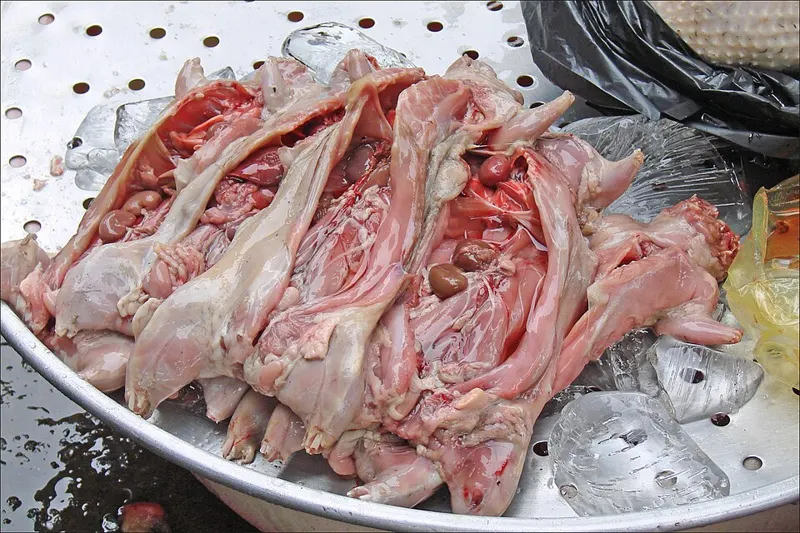
Rat meat at Sa Dec market, Vietnam. Photo: dalbera, CC BY 2.0
TRUE RATS
Vietnam, Cambodia, Thailand
Rice-field rats are sold at markets in the Mekong Delta and grilled, fried or stewed. People call them clean because they live on rice, not garbage.
CANE RATS, NOT TRUE RATS
Ghana, Nigeria, West Africa
The grasscutter, or cane rat, is a prized bushmeat, often sold smoked by the roadside. It's now farmed too. Adults weigh several kilos.
TRUE RATS
India: the Musahar, the Adi
The Musahar of Bihar take their name from catching field rats. In Arunachal Pradesh, the Adi people treat rat as a delicacy and a gift.
SURVIVAL
Paris, 1870
During the Prussian siege, starving Parisians bought rats at market, along with cats, dogs and in the end the zoo animals.
NUTRIA, NOT TRUE RATS
Louisiana, USA
Nutria, big invasive swamp rodents, wreck the wetlands. Louisiana pays a bounty on them, and chefs have tried to put them on menus.
HUTIA, NOT TRUE RATS
Cuba
The hutia, a rat-shaped native rodent, is hunted and eaten in Cuba's countryside.
HEALTHWild rats can carry leptospirosis, hantavirus and other diseases. Where rat is eaten safely, it comes from rice fields or farms, not cities.
EXPORT
SAVE IMAGEOn a phone, press and hold the image to save it.